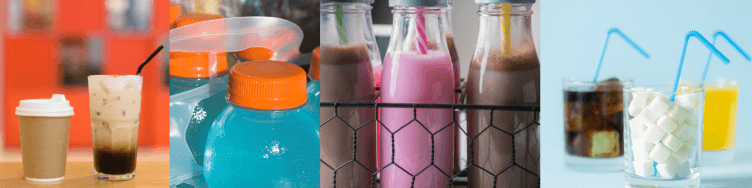
If I had to pick one food or drink[1] that was the worst for health, longevity, and maintaining a healthy body weight, it would be sugary drinks. These include soda, energy and sports drinks, flavored milk, lemonade, fruit drinks, tonic, flavored waters, teas and coffees flavored with sugar or syrup, milkshakes, and frappes. The World Cancer Research Fund (WCRF), as part of their Third Expert Report published in 2018, analyzed all of the evidence on what causes weight gain and obesity. Only one item for adults[2] was so clear it reached their highest level of grading, what they call “convincing evidence” – consuming sugar sweetened drinks.
Between 1965 and 2000 the average calories from sugary drinks quadrupled. The average size of a soda sold in the U.S. has more than doubled from 6.5 ounces to 16.2 ounces.[3] Most Americans now consume at least one sugary drink every day, with soda being the most common. Those who consume sugary drinks average about 350 calories per day from them.[4] This massive consumption of sugary drinks is due in part to the more than 1.2 billion dollars being spent every year by the beverage industry on marketing. The marketing is often geared towards children, low-income individuals, and people of color, which may explain why these groups consume more sugary drinks and their associated health problems. Nearly 10% of all calories consumed by teenagers and young adults are from sugary drinks.
Sugary drinks are worse than foods with added sugar because when calories are in liquid form and are drank they don’t make you feel as full.[5] They bypass our defenses against consuming too many calories. Liquids don’t have to be broken down and digested like food so many of the hormones, such as leptin, PYY, and CCK, that are triggered during digestion to make us feel full don’t come into play with liquid calories. Our stomachs also clear liquids much more quickly than solid foods, so the stretch receptors in our stomach often won’t be triggered with liquids. In a 2000 study, researchers had one group consume 450 calories each day from soda and another group consume the same amount of calories per day from jelly beans. Those drinking the soda gained more weight.[6] If you just cut out one soda per day you could lose 5 pounds in a few months without changing anything else about your diet or activity level. And if you cut out 350 of these empty calories per day (the amount of calories in a large drink at many fast food restaurants), you could lose 10 pounds in less than three months.
When it comes to maintaining a healthy weight and controlling blood sugar, 100% fruit juice isn’t much better than other sugary drinks. Fruit juice is associated with increased type 2 diabetes[7] and increased weight.[8] The U.S. Department of Health and Human Services (HHS), the WCRF, the Dietary Guidelines for Americans, the American Academy of Pediatrics, and every other public health organization I can think of recommend whole fruit over fruit juice. If you do drink juice, HHS recommends limiting it to a small serving of 4 ounces or less.[9] Fruit juice isn’t recommended at all for those under the age of 2 and it is especially important to not give juice to kids younger than 1.[10]
There are a lot of misunderstandings around sugary drinks. For example, 20% of parents think sports drinks are healthy for children and more than 25% think fruit-flavored drinks are healthy.[11] About 62% of parents give soda to children.[12]
Children who consume sugary drinks have more than double the odds of being overweight than children who do not drink sugary drinks.[13] Greater consumption of sugary drinks during childhood or adolescence also predicts weight gain as adults.[14]
Observational studies indicate sugary drinks, as well as artificially sweetened drinks, increase overall mortality rates, driven mostly by heart disease, in a dose-dependent fashion.[15] In other words, the more sugary drinks you consume the higher the risk you will die during a given time period. A 2004 study found that during 8 years women who drank more than one sugary drink per day had a 83% greater risk of developing type 2 diabetes compared to those consuming less than one sugary drink per month.[16] Similarly, a 2016 study found that for every 7 ounces of sugary drinks consumed, the risk of diabetes increased by 20%.[17]
Part of the problem with sugary drinks is weight gain, but independent of weight gain sugary drinks also lead to insulin resistance, dysfunctional beta cells that make insulin, inflammation, high blood pressure, belly fat, and high cholesterol.[18] The caramel coloring in colas may also be causing thousands of additional deaths from cancer each year.[19] The health effects of sugary drinks are so bad, some organizations recommend warning labels. And recent studies indicate these warnings would work.[20]
The best advice for beverages is to try to avoid all liquid calories, and this is what health organizations are finally telling us. HHS reminds us to “reach for water first” when we are thirsty and the latest Canadian Dietary Guidelines tell us to “make water your drink of choice”.[21] Individuals who drink plain water consume about 200 calories less per day than non-water drinkers.[22] Drinking water with your meal also makes you feel fuller and eat less calories.[23]
How many calories do you think you consume a day in liquid form?
About the Author: Keith Herman is an estate planning attorney who is also passionate about nutrition and helping others live their healthiest lives. Keith has certifications in nutrition and personal training.
#HealthyEating #HealthyLifestyle #Wellness
[1] Other than alcohol, which may be worse. Burton R, Sheron N. No level of alcohol consumption improves health. Lancet. 2018 Sep 22;392(10152):987-988. Flor LS, Gakidou E.
The burden of alcohol use: better data and strong policies towards a sustainable development. Lancet Public Health. 2020 Jan;5(1):e10-e11.
GBD 2016 Alcohol Collaborators. Alcohol use and burden for 195 countries and territories, 1990-2016: a systematic analysis for the Global Burden of Disease Study 2016. Lancet. 2018 Sep 22;392(10152):1015-1035.
[2] One other item was convincingly related to weight gain, but it was only with respect to children – spending time in front of a screen. Screen time is a marker of low physical activity, consumption of high calorie foods and drinks, and it exposes you to marketing of unhealthy foods and drinks. There is “probable” evidence screen time causes weight gain in adults.
[3] Woodward-Lopez G, Kao J, and Ritchie L. (2011). To what extent have sweetened beverages contributed to the obesity epidemic? Public Health Nutr, 14(3): 499-509.
[4] Healthy Food America (2017), NHANES 2005-2012. Unpublished data. See https://www.healthyfoodamerica.org/sugary_drinks_in_america_who_s_drinking_what_and_how_much
[5] Cassady BA, et al. Beverage consumption, appetite, and energy intake: what did you expect? Am J Clin Nutr. 2012 Mar;95(3):587-93.
Houchins JA, et al. Effects of fruit and vegetable, consumed in solid vs beverage forms, on acute and chronic appetitive responses in lean and obese adults. Int J Obes (Lond). 2013 Aug;37(8):1109-15.
Pan A, Hu FB. Effects of carbohydrates on satiety: differences between liquid and solid food. Curr Opin Clin Nutr Metab Care. 2011 Jul;14(4):385-90.
DellaValle DM, Roe LS, Rolls BJ. Does the consumption of caloric and non-caloric beverages with a meal affect energy intake? Appetite. 2005 Apr;44(2):187-93.
DiMeglio DP, Mattes RD. Liquid versus solid carbohydrate: effects on food intake and body weight. Int J Obes Relat Metab Disord. 2000 Jun;24(6):794-800.
Mattes RD. Dietary compensation by humans for supplemental energy provided as ethanol or carbohydrate in fluids. Physiol Behav. 1996 Jan;59(1):179-87.
[6] DiMeglio DP, Mattes RD. Liquid versus solid carbohydrate: effects on food intake and body weight. Int J Obes Relat Metab Disord. 2000 Jun;24(6):794-800.
[7] Bazzano LA, et al. Intake of fruit, vegetables, and fruit juices and risk of diabetes in women. Diabetes Care. 2008 Jul;31(7):1311-7.
[8] Schulze MB, et al. Sugar-sweetened beverages, weight gain, and incidence of type 2 diabetes in young and middle-aged women. JAMA. 2004 Aug 25;292(8):927-34.
Sanigorski AM, et al. Association of key foods and beverages with obesity in Australian schoolchildren. Public Health Nutr. 2007 Feb;10(2):152-7.
[9] Make Healthy Drink Choices. 2021. Office of Disease Prevention and Health Promotion. Available at https://www.dietaryguidelines.gov/sites/default/files/2021-12/DGA_Beverages_FactSheet-508c.pdf
[10] Make Healthy Drink Choices. 2021. Office of Disease Prevention and Health Promotion. Available at https://www.dietaryguidelines.gov/sites/default/files/2021-12/DGA_Beverages_FactSheet-508c.pdf
Heyman MB, et al. Fruit Juice in Infants, Children, and Adolescents: Current Recommendations. Pediatrics. 2017 Jun;139(6):e20170967.
[11] Zytnick D, et al. Child and Caregiver Attitudes About Sports Drinks and Weekly Sports Drink Intake Among U.S. Youth. Am J Health Promot. 2016 Jan-Feb;30(3):e110-9.
Munsell CR, et al. Parents’ beliefs about the healthfulness of sugary drink options: opportunities to address misperceptions. Public Health Nutr. 2016 Jan;19(1):46-54.
[12] Zytnick D, et al. Child and Caregiver Attitudes About Sports Drinks and Weekly Sports Drink Intake Among U.S. Youth. Am J Health Promot. 2016 Jan-Feb;30(3):e110-9.
Munsell CR, et al. Parents’ beliefs about the healthfulness of sugary drink options: opportunities to address misperceptions. Public Health Nutr. 2016 Jan;19(1):46-54.
[13] Dubois L, et al. Regular sugar-sweetened beverage consumption between meals increases risk of overweight among preschool-aged children. J Am Diet Assoc. 2007 Jun;107(6):924-34; discussion 934-5.
[14] Nissinen K, et al. Sweets and sugar-sweetened soft drink intake in childhood in relation to adult BMI and overweight. The Cardiovascular Risk in Young Finns Study. Public Health Nutr. 2009 Nov;12(11):2018-26.
[15] Malik VS, et al. Long-Term Consumption of Sugar-Sweetened and Artificially Sweetened Beverages and Risk of Mortality in US Adults. Circulation. 2019 Apr 30;139(18):2113-2125.
Swithers SE. Not so Sweet Revenge: Unanticipated Consequences of High-Intensity Sweeteners. Behav Anal. 2015 Mar 12;38(1):1-17.
Vyas A, et al. Diet drink consumption and the risk of cardiovascular events: a report from the Women’s Health Initiative. J Gen Intern Med. 2015 Apr;30(4):462-8.
[16] Schulze MB, et al. Sugar-sweetened beverages, weight gain, and incidence of type 2 diabetes in young and middle-aged women. JAMA. 2004 Aug 25;292(8):927-34.
[17] Löfvenborg JE, et al. Sweetened beverage intake and risk of latent autoimmune diabetes in adults (LADA) and type 2 diabetes. Eur J Endocrinol. 2016 Dec;175(6):605-614.
[18] Malik VS, et al. Sugar-sweetened beverages, obesity, type 2 diabetes mellitus, and cardiovascular disease risk. Circulation. 2010 Mar 23;121(11):1356-64.
[19] Smith TJ, et al. Caramel color in soft drinks and exposure to 4-methylimidazole: a quantitative risk assessment. PLoS One. 2015 Feb 18;10(2):e0118138.
Jacobson MF. Carcinogenicity and regulation of caramel colorings. Int J Occup Environ Health. 2012 Jul-Sep;18(3):254-9.
Hengel M, Shibamoto T. Carcinogenic 4(5)-methylimidazole found in beverages, sauces, and caramel colors: chemical properties, analysis, and biological activities. J Agric Food Chem. 2013 Jan 30;61(4):780-9.
[20] Mantzari, Eleni et al. “Impact of warning labels on sugar-sweetened beverages on parental selection: An online experimental study.” Preventive medicine reports vol. 12 259-267. 23 Oct. 2018.
Leung CW, et al. Warning Labels Reduce Sugar-Sweetened Beverage Intake among College Students. J Nutr. 2021 Jan 4;151(1):179-185.
[21] Make Healthy Drink Choices. 2021. Office of Disease Prevention and Health Promotion. Available at https://www.dietaryguidelines.gov/sites/default/files/2021-12/DGA_Beverages_FactSheet-508c.pdf
[22] Popkin BM, et al. Water and food consumption patterns of U.S. adults from 1999 to 2001. Obes Res. 2005 Dec;13(12):2146-52.
Stookey JD, et al. Replacing sweetened caloric beverages with drinking water is associated with lower energy intake. Obesity (Silver Spring). 2007 Dec;15(12):3013-22.
[23] Dennis EA, et al. Water consumption increases weight loss during a hypocaloric diet intervention in middle-aged and older adults. Obesity (Silver Spring). 2010 Feb;18(2):300-7.
Join over 10k subscribers
By submitting above, you agree to our privacy policy.

Keith Herman is a certified nutrition coach, personal trainer, and estate planning attorney. He is an elected Fellow of the American College of Trust and Estate Counsel, a former adjunct professor at Washington University in St. Louis School of Law, and winner of the Excellence in Writing Award from the American Bar Association.
Keith is the creator of the Health & Well-Being JournalTM, a daily accountability planner for optimizing your mind, body, and spirit, and tracking healthy behaviors.
He is also the author of Eat Like an Expert: How to Start Eating Healthy (and Stick to It), which combines the best of plant-based, Mediterranean, low-carb, and anti-inflammatory diets to create a customizable plan that delivers transformational results.
You can find more information about Keith at KeithAHerman.com
In 50 years, I have learned a lot about myself, and how to be...

Do you want to feel, look, or be healthier? Is it important for you...

In my previous articles we looked at how a diet rich in plant foods...