March 4, 2022

I am going to try and clear up a misunderstanding about carbohydrates. Some people refer to junk foods, refined grains, and foods high in sugar as “carbs”. This creates a lot of confusion as it is not the carbs in these foods that cause health problems.
Carbohydrates are formed by green plants from carbon dioxide and water during photosynthesis. The word carbohydrate means “hydrated carbon.” Carbohydrates are composed of sugar molecules. There are four types of carbohydrates and they are categorized by the number of sugar units they contain. Monosaccharides have one sugar unit, disaccharides have 2, oligosaccharides have 3 – 10 sugar units, and polysaccharides have more than 10. Saccharide means sugar and the term polysaccharide means “many sugars”. Monosaccharides and disaccharides are classified as “simple carbohydrates” whereas oligosaccharides and polysaccharides are called “complex carbohydrates”. This is easier to understand with a picture.

What do these terms have to do with whether a food is healthy? Absolutely nothing. None of these terms are meaningful for choosing healthy foods – they are only meaningful to chemists.
The sugar in cotton candy and the sugar in a blueberry are both simple carbohydrates. The starch in a piece of white bread and the starch in whole grain oats are both complex carbohydrates. When you take the starch in a healthy wheat kernel and process it into refined white flour, then add it to a birthday cake with added sugar and fat, it doesn’t transform the starch in the wheat from a complex carbohydrate into a simple carbohydrate. It will always be a complex carbohydrate. Sugar is always a simple carbohydrate and starch is always a complex carbohydrate. One isn’t necessarily better than the other.
You must look at the entire food to know if it is healthy. A blueberry is a healthy food even though the sugars are simple carbohydrates. A piece of white bread is not a healthy food even though the starch is a complex carbohydrate.
We can all be excused for our misunderstanding because we were taught wrong. The idea that we should focus on eating “complex carbohydrates” came from the original 1980 Dietary Guidelines for Americans:
Complex carbohydrates are better than simple carbohydrates … Complex carbohydrate foods – such as beans, peas, nuts, seeds, fruits and vegetables, and whole grain breads, cereals and products – contain many essential nutrients in addition to calories.
Their use of the term complex carbohydrate was clearly wrong. This is from the same organization that gave us the original 1992 Food Pyramid where the base of the pyramid was bread, pasta, crackers, and breakfast cereals, with an extra unhealthy sprinkling of added sugar and fats.

Image: United States Department of Agriculture
Thankfully, the terms simple carbohydrate and complex carbohydrate have vanished from the Dietary Guidelines for Americans, but this notion that complex carbs are the healthy ones persists today, even among those giving nutrition advice.
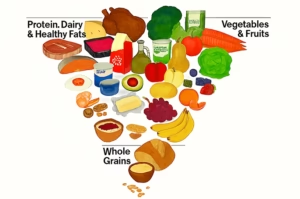
Ignore carbs and focus on eating the foundational diet of healthy foods I described at the end of my article, The Four Most Important Foods to Improve Brain Health and Reduce your Risk of Dementia and Alzheimer’s Disease. Carbs are not our problem. It is the foods with added sugar and refined white flour that are causing health problems. Look back at the quote from the 1980 Dietary Guidelines for Americans. They got the list of foods right – focus on eating whole unrefined plant foods with no added sugar.