Phytonutrients are the nutrients found mostly in plants that are not classified as vitamins. Last time we reviewed the carotenoids, especially lutein and zeaxanthin. Now let’s look at polyphenols and how they are silently guarding our health.
Polyphenols are one of the most researched categories of phytonutrients and are the most abundant antioxidant in the human diet. There are more than 8,000 types of polyphenols. The primary categories of polyphenols are lignans, flavonoids, stilbenes, tannins, coumarins, and phenolic acids.[1] Foods high in polyphenols include herbs and spices, darkly colored berries and grapes, cocoa products, tea, coffee, citrus fruits, flax seeds, hazelnuts, and certain vegetables such as olives.[2] They improve digestion and protect against heart disease, type 2 diabetes, and certain cancers. Flavonoids have been studied extensively with respect to brain health and learning.
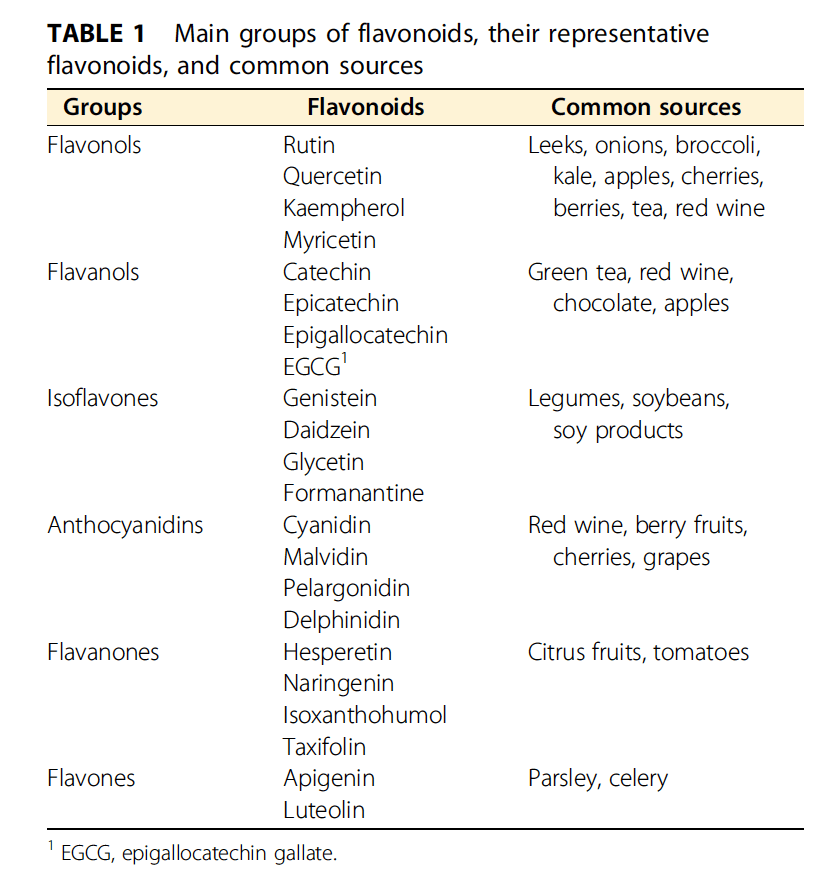
Image: Flavonoid-based therapies in the early management of neurodegenerative diseases. Adv Nutr. 2015 Jan 15;6(1):64-72.
Blueberries and Purple Grapes
A 2012 study published in the Journal of Nutrition found that among middle aged adults, those consuming the highest amounts of flavonoids had better language and verbal memory.[3] Another 2012 study, this one published in the Annals of Neurology, found a high intake of flavonoids in blueberries and strawberries was associated with an improvement in brain functioning equal to about 2.5 years.[4] This may not seem like much now, but it can make a big difference in your 80s and 90s.
Anthocyanins, a specific type of anthocyanidin found in blackberries, blueberries, and purple grapes, have been associated with a lower risk of dementia and Alzheimer’s disease. In 2019 researchers from the University of London and University of Reading gave 7-10 year-old children a wild blueberry powder drink with 250 mg of anthocyanins (equal to about 240 grams of fresh blueberries) or a placebo drink.[5] The children who drank the wild blueberry powder could sustain their attention longer during the school day. The children also had quicker reaction times and better memory. The researchers hypothesized the reason for the improvement was due to increased blood flow to the brain.
In another 2019 study out of the University of Reading, researchers gave adults, average age 23, a smoothie with only water and berries, standardized to have about 250 mg of anthocyanins. The smoothie had 300 grams of berries with equal amounts of whole blueberry, strawberry, raspberry, and blackberry.[6] An hour and a half to six hours after drinking the smoothie they gave the participants a series of brain tests. Those drinking the smoothie scored well on a variety of cognitive tests for a longer period. From these studies it appears blueberries may allow us to maintain concentration for longer.
Concord grapes appear to have similar benefits to berries. In 2017 researchers gave a commercially available purple Concord grape juice (with 138 mg of anthocyanins) to healthy young adults. Those drinking the anthocyanin-rich grape juice had improved reaction time.[7] Another Concord grape juice study showed that after 12 weeks of drinking the juice elderly adults with mild cognitive impairment had improvements in verbal learning.[8]
Anthocyanins in blueberries, apples, and pears are also linked to a decreased risk of type 2 diabetes.[9]
Cocoa
Cocoa is another popular food known for its polyphenol content. In a 2011 study, those eating a dark chocolate bar containing 720 mg of cocoa flavanols (similar to the amount of flavanols in about two 85% dark chocolate bars) had improved eyesight and certain cognitive functions that could be explained by the improved blood flood to the brain and eyes.[10] Other studies of cocoa products with 520 to 990 mg of flavanols show benefits to thinking speeds and verbal fluency, as well as reductions in blood pressure, cholesterol, and insulin resistance.[11] The benefits applied to those with mild cognitive impairment and healthy older people.
Coffee
A moderate daily intake of 3-4 (8 ounce) cups of plain black coffee has been linked to a reduced risk of dementia, Alzheimer’s disease, type 2 diabetes, Parkinson’s disease, and certain cancers, such as liver and endometrial cancer.[12] According to a 2021 analysis, coffee may also reduce the risk of heart failure.[13] Chlorogenic acids (CGA) are the main polyphenol in coffee. Some of the benefit to drinking coffee seems to be from the polyphenol content, especially for Alzheimer’s disease and dementia risk. In a 2019 study, participants drinking a beverage with a high concentration of CGA (1,000 mg) for 12 weeks improved their concentration and executive function.[14] A cup of coffee on average has about 50-100 mg of CGA.
The reduced risk of Parkinson’s disease appears to be from the caffeine, but coffee contains thousands of other potentially beneficial compounds, such as lignans and other flavonoids.
Whether coffee is a healthy beverage has been the subject of debate for some time. Based on the current evidence it appears to be a healthy choice, unless the caffeine causes jitters, anxiety, stomach upset, or affects your sleep. In which case, consider switching to decaf which still has many of the health benefits. It takes 4 to 7 hours for half of the caffeine to leave your system, so be careful with caffeine after noon. The 2020-2025 Dietary Guidelines for Americans point out caffeine passes through breast milk to infants, but it usually doesn’t have adverse effects if the mother consumes 300 mg or less of caffeine (about 2 to 3 cups of coffee). If your LDL cholesterol is above 100, avoid unfiltered coffee such as French press, espresso, Greek style, Moka pot, boiled coffee, or Turkish style brews. Certain coffee oils, such as cafestol and kahweol, can raise LDL.[15] A paper filter or coffee sock will remove most of these oils.
Tea[16]
Tea is the most widely consumed beverage in the world. It is made from the leaves of the Camellia sinensis plant. White, green, oolong, black, and Pu-erh teas are all made from this same plant. Different processing methods produce the different types of tea. Tea contains more than 2,000 components including polyphenols, caffeine, lignans, L-theanine, vitamin C, vitamin E, riboflavin, and minerals. Tea is rich in flavonoids, especially catechins such as epigallocatechin gallate (EGCG) and flavonols such as quercetin and kaempferol.
Studies indicate drinking tea reduces the risk of heart disease. This may be due to tea’s effects on lowering cholesterol and blood pressure or due to its anti-inflammatory and antioxidant effects. Tea also seems to play a role in the prevention of cognitive decline and Parkinson’s disease. Don’t confuse drinking tea with consuming a supplement made from isolated nutrients found in tea. Drinking up to 8 cups of tea a day seems to be safe.[17] However, in some studies green tea extracts have caused stomach disorders and liver toxicity.[18]
Healthy Beverages
The research on coffee and tea indicate they are generally good for you and without major side effects, other than the issues with caffeine and cholesterol mentioned above. Also, studies suggest drinking very hot beverages (above 149 degrees Fahrenheit), such as coffee or tea, may increase the risk of esophageal cancer, so it is best to avoid drinking any beverages at very hot temperatures.[19]
The quote below from the Global Council on Brain Health summarizes the research related to brain health, but the research for other diseases is similar.[20]
Several studies have found an association between drinking coffee and tea and decreased risk of cognitive decline and dementia. There is plausible reason to believe that compounds in tea and coffee called polyphenols may have antioxidant benefit. However, there is no consensus on whether, and at what amounts, tea and/or coffee may be beneficial or harmful for brain health. Short-term effects of caffeine consumption from coffee and tea have been shown to increase alertness and cognitive performance, but the long-term effects are less understood. There have been several studies suggesting that those who drink coffee have better cognitive function over time than those who drink less coffee. However, it is possible that the caffeine or compounds in coffee and tea may not be the cause of improved outcomes, but rather that people who drink tea and coffee are also more likely to have higher education levels or better health, which are tied to improved cognitive performance and lower risk of dementia. While we are not aware of moderate tea or coffee consumption causing harm to cognitive health, if you don’t currently drink coffee and tea with caffeine, we don’t recommend that you start to do so for your brain health.
Although we are not certain about the long-term health benefits of black coffee and unsweetened tea, they are both clearly better choices than sugary drinks.
How often do you eat foods with polyphenols?
About the Author: Keith Herman is an estate planning attorney who is also passionate about nutrition and helping others live their healthiest lives.
#HealthyEating
#HealthyLifestyle
#Wellness