Every five years the US Department of Agriculture (USDA) and US Department of Health and Human Services (HHS) update the Dietary Guidelines for Americans (DGA).
Publishing the DGA is a two-part process. First, the Advisory Committee (experts in health and nutrition) reviews the evidence and publishes a Scientific Report (“Experts’ Report”). The Advisory Committee ends their report with a list of items they recommend be included in the actual DGA. The Secretary of HHS (Robert F. Kennedy, Jr.) and the Secretary of the USDA (Brooke L. Rollins) then review those recommendations and prepare the DGA. They are politicians (“politicians”).
To summarize, the experts draft a report based on the evidence. Then politicians draft the official DGA and are free to ignore anything they want. If your goal is to educate yourself on what is a healthy way to eat, then the DGA are mostly irrelevant. The Experts’ Report is what is based on the evidence.
The 2025 Experts’ Report exceeded 400 pages and was supported by thousands of additional pages of systematic literature reviews and other supporting reports. You can find links to them here.
The 2025-2030 DGA is nine pages.
The Experts’ Report made many recommendations the politicians ignored. This is not unusual. The 2020 Experts’ Report made several recommendations that were also ignored, such as to further limit alcohol and added sugar consumption.
Below are recommendations from the 2025 Experts’ Report that were ignored:
With all the headlines around the new DGA, I thought we were in for a real shock. But that’s not the case. Even with all the controversy and mixed messages in the media, the new guidelines are similar to the previous version. They continue to recommend a mostly plant-based diet.
| 2020-2025 DGA | 2025- 2030 DGA | |
| Cups | Cups | |
| Fruit | 2 to 2.5 | 2 |
| Vegetables | 2.5 to 3.5 | 3 to 4 |
| Whole Grains | 1.5 to 1.75 | 1 to 2 |
| Soy or Dairy | 2 to 3 | 3 |
| Sodium Limit: | 2,300 mg | Same |
| Saturated fat Limit: | 10% of calories (22 g/day) | Same |
| Added Sugars Limit: | 10% of calories (50 grams/day) | No more than 10 g/meal |
I have read articles about how great the new DGA are because they finally recommend avoiding “highly processed” foods. Newsflash: they have been doing that for decades. However, they used slightly different language in the past. The previous DGA warned us about the health issues of consuming “processed meat.” They also recommended consuming “nutrient-dense” foods prepared without added sugar, added salt, or added saturated fat.
The foods recommended by the DGA have never changed much—because the evidence has been consistent about the basics of good nutrition. The original 1980 DGA recommended limiting saturated fat, alcohol, sodium, and added sugar It also recommended consuming a variety of fruit, vegetables, legumes, and whole grains. Sound familiar?
The 2025-2030 guidelines make four improvements.
Their updated added sugar advice says,
While no amount of added sugars or non-nutritive sweeteners is recommended or considered part of a healthy diet, one meal should contain no more than 10 grams of added sugars.
This is an improvement over the 2020-2025 DGA’s advice to limit added sugars to less than 10% of calories. To put this in context, the 2020 Experts’ Report recommended limiting added sugars to 6% of calories and the World Health Organization recommends limiting to no more than 5% of calories (5% of calories is 25 grams if based on 2,000 calories).
The new guidelines state, “Consume less alcohol for better overall health.” This is a better message than the outdated advice for men to limit to two drinks/day and women to limit to one. What most people don’t realize is that the 2020-2025 DGA had a sneaky little disclaimer:
Even drinking within the recommended limits (two drinks a day or less for men and one or less for women) may increase the overall risk of death from various causes, such as from several types of cancer and some forms of cardiovascular disease and therefore, caution is recommended.
The prior DGA gave into pressure from the alcohol industry (remember, they are written by politicians, not experts) and refused to lower the limit on alcohol. Instead, they added that disclaimer no one talks about.
The current evidence shows there is no safe level of alcohol consumption. Alcohol increases the risk of at least eight types of cancer and causes about 750,000 cancer cases a year. According to Global Burden of Disease, the “healthiest amount of alcohol to consume is zero.” The World Cancer Research Fund warns, “for cancer prevention, it is best not to drink alcohol.” The World Health Organization no longer sets a limit on alcohol because “the evidence shows that the ideal solution for health is not to drink at all.”
The prior DGA gave into food industry pressure to not put a limit on refined grains. Instead, they gave a confusing recommendation to make half of your grain consumption whole grains. The new DGA tell us to “Significantly reduce the consumption of highly processed, refined carbohydrates, such as white bread, ready-to-eat or packaged breakfast options, flour tortillas, and crackers.” That is a step in the right direction.
The new DGA recommend consuming daily 1.2 to 1.6 grams of protein per kilogram of body weight (.54 to .73 grams per pound). This is similar to the International Society of Sports Nutrition’s recommendation of 1.4 to 2 grams per kilogram of body weight per day (.64 to .9 grams of protein per pound) to optimize muscle growth.
The prior DGA used the National Academy of Medicine’s .8 grams per kilogram RDA for protein. But that amount is only the minimum needed to prevent your body from consuming its own tissue to meet its protein needs. Prior DGAs never recommended an optimal protein amount for building muscle or strong bones.
Although the new DGA maintain the 10% limit on saturated fat, they give some very confusing mixed messages. Here are two problematic statements:
Healthy fats are plentiful in many whole foods, such as meats, poultry, eggs, omega-3-rich seafood, nuts, seeds, full-fat dairy, olives, and avocados.
…
[P]rioritize oils with essential fatty acids, such as olive oil. Other options can include butter or beef tallow.
Full fat dairy, butter, and beef tallow are all high in saturated fat. Every health organization I know of recommends limiting those foods. Saturated fat increases LDL, the bad cholesterol. And increased LDL is the primary cause of heart disease. As 1/3 of all humans die of heart disease, we should be mindful to avoid these foods that are high in saturated fat. Here is a simple way to tell whether a plant oil or animal fat is too high in saturated fat: If it is solid at room temperature then it is too high in saturated fat. Choose oils that are liquid at room temperature. Think about the oil running smoothly through arteries as opposed to the solid fats clumping up and clogging your arteries.
Solid Fats to Avoid
Lard (pork fat), bacon grease, chicken fat, tallow (beef fat), butter, ghee (clarified butter), shortening, palm oil, palm kernel oil, coconut oil, and coconut cream.
None of this is controversial or subject to debate among health and nutrition experts. Only influencers and pretend experts argue about whether saturated fat increases cholesterol. [If you are interested in how to prevent heart disease according to the actual science, check out my article here.
The new DGA’s messaging around full-fat dairy, butter, and beef tallow is the opposite of what the Experts’ Report recommended.
The prior DGA reminded us that a higher intake of red or processed meat is associated with “detrimental health outcomes.” This statement is missing from the new DGA. The Experts’ Report kept the guidance to limit red and processed meat, but the politicians ignored it.
Processed Meat. Most dietary guidelines recommend limiting processed meat. The World Cancer Research Fund recommends consuming no processed meat because all levels increase the risk of colorectal cancer (and potentially nasopharynx, esophageal, lung, prostate, and pancreatic cancers).
Processed meat includes:
sausage, bacon, ham, pepperoni, bratwursts, hot dogs, bologna, pastrami, chorizo, salami, corned beef, beef jerky, turkey jerky, fish jerky, dried and smoked fish, canned meat, and other deli meats/cold cuts.
Every 50 grams of processed meat a day increases the risk of colorectal cancer by 16% (a large hot dog is about 100 grams).
Red Meat. The World Cancer Research Fund recommends limiting red meat to no more than 18 ounces per week (about three portions). Public Health England recommends 17 ounces or less per week.
The new DGA mention how vegetables, fruit, other high fiber foods, and fermented foods (like sauerkraut and kimchi) support a diverse microbiome. The reference to fermented foods could cause problems due to the sodium content.
Salt and Heart Disease. About 89% of Americans already consume more than 2,300 mg of sodium per day (the daily limit). Consuming too much sodium increases blood pressure, and blood pressure above 120/80 increases the risk of heart disease. A cup (about 142 grams) of sauerkraut has a whopping 939 mg of sodium. Adding another 900 mg of sodium to an otherwise high-sodium diet is a recipe for disaster.
Salt and Cancer. High salt foods also increase the risk of cancer. The World Cancer Research Fund found strong evidence foods preserved by salting increases the risk of stomach cancer and nasopharnyx cancer (a rare type of head and neck cancer). This includes salted and dried fish, pickles, kimchi, sauerkraut, and other pickled vegetables. Every 40 grams of pickled vegetables (about one pickle spear) eaten a day increases the risk of stomach cancer by about 18%.
The quote earlier under “Healthy Fats” recommends eating olives. Health organizations often recommend olive oil, but not whole olives. Olives are a pickled vegetable (technically they are fruit, but they are treated as vegetables in food guidelines). They fall under the World Cancer Research Fund’s advice to not consume foods preserved by salting. Ten olives can have between 400 and 900 mg of sodium.
High salt levels strip away the stomach’s protective mucus. This allows dangerous compounds (N-nitroso compounds and H. pylori) to form. These compounds damage your stomach lining, creating lesions that can eventually turn into cancer.
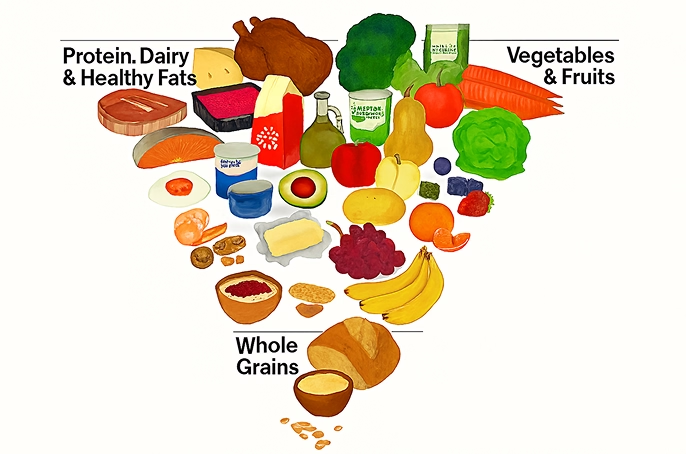
The new DGA have a new upside-down pyramid. I don’t have anything to say about this because I don’t know what it means. The diagram doesn’t give any information on what we should be eating more or less of. It is a bunch of random foods in the shape of a triangle.
Rather than focusing on what any single set of guidelines recommends, I find it more useful to look at where the major nutrition guidelines overlap.
When you take a broad view of recommendations from organizations such as the World Cancer Research Fund, World Health Organization, Global Burden of Disease, American Heart Association, Global Council on Brain Health, and EAT-Lancet Commission, a clear pattern emerges. Their advice is remarkably consistent, and it aligns with most of the new DGA.
Below are the core elements of a healthy diet that most health organizations agree on. While they may differ slightly on exact targets (such as the precise number of cups of fruits or vegetables per day), the underlying recommendations are mostly the same.
Following these guidelines will help you reach and maintain a healthy body weight and reduce your risk of heart disease, cancer, Alzheimer’s disease, and type 2 diabetes.
The Advisory Committee’s 2025 Systematic Literature Review on obesity summarizes this well:
Higher intakes of vegetables, fruits, legumes, nuts, whole grains, fish/seafood; and lower intakes of meats (including red and processed meats), refined grains and sugar-sweetened foods and beverages are associated with lower adiposity (body fat, body weight, BMI, and/or waist circumference) and risk of obesity. These dietary patterns also included higher intakes of unsaturated fats and lower intakes of saturated fats and sodium.
If all you did was eat the plant foods listed above under item 1, you wouldn’t have enough room in your diet for much of the Limit foods.
If you want to check the science, my articles on heart disease (here) and brain health (here) include detailed citations to the evidence.
And here is my how to prevent heart disease cheat sheet that includes the most important foods for reducing your risk of dying from the world’s # 1 killer.