September 9, 2021

Instead of focusing on a label, I find it helpful to divide healthy eating into two categories to keep things simple.
In this article I will do my best to explain the healthiest foods without any theories, biological mechanisms, or stories about what our prehistoric ancestors ate. Let’s stick to the advice from the experts.
World Cancer Research Fund Recommendations
In my last article1 I described why I believe the World Cancer Research Fund (WCRF) (and its U.S. affiliate, the American Institute for Cancer Research) has the most accurate, reliable, unbiased, and accessible information on healthy eating. Their 12,000-page Third Expert Report from 2018 is the most comprehensive and transparent analysis ever done of how food affects the risk of 17 types of cancer.2 Their comprehensive database of studies is even available to the public for use in research.
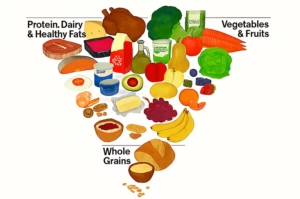
Below is a summary of their recommendations and other findings related to healthy foods:

Image: American Institute for Cancer Research
Healthy Foods
To optimize your diet for the prevention of cancer, the foods to eat more of, in unlimited amounts, are plants, specifically non-starchy vegetables, fruit, whole grains, and legumes. Non-starchy vegetables are veggies other than corn and potatoes. Corn and potatoes can be part of a healthy diet, but you also need to ensure you are eating sufficient non-starchy vegetables.7
Contrary to what you may hear in the media or popular diet books, there are no specific plant foods you need to avoid, and “anti-nutrients” are nothing you need to worry about.8 All beans and legumes are healthy, especially soy.9
Popular diet books may be scaring people away from eating healthy whole grains. Carbs, wheat, and gluten are not the problem. The problem is refined flour, especially when that flour is combined with added oil, sugar, and salt. Whole grain breads and pasta can be OK, but are not ideal. Whole grain bread is usually not 100% whole grain and often has added sugar and too much sodium. Whole grain pasta does not usually come packaged with the added salt and sugar, but the pasta sauces have the added sugar and salt. Intact whole grains are a much healthier choice. “Intact” whole grains are not pulverized into flour. You cook them in water. They include oats, hulled (not pearled) barley, rye, brown/black/red/wild rice, quinoa, bulgur, sorghum, einkorn, emmer/farro, freekeh, kamut, spelt, teff, amaranth, buckwheat, millets, fonio, and triticale. These are much healthier choices than even 100% whole grain bread or pasta.
Global Burden of Disease Study
The WCRF was careful to ensure their recommendations did not increase the risk of the other major chronic diseases such as heart disease, stroke, obesity, type 2 diabetes, and dementia.
However, their recommendations are not optimized to decrease the risk of these other diseases. Let’s compare the WCRF recommendations to the Global Burden of Disease (GBD) analysis of the optimal diet for reducing the risk of some of the most common chronic diseases.
GBD is a ground-breaking approach to quantifying the diseases, and causes of those diseases, killing humans all over the planet. Originally, GBD was a part of the World Health Organization, but it was moved to Harvard briefly to avoid influence from the member countries. After the Bill & Melinda Gates Foundation agreed to fund the program, GBD was moved to the University of Washington as part of the (then) newly created Institute for Health Metrics and Evaluation (IHME). GBD’s goal is to answer these questions.
Due to the Bill & Melinda Gates Foundation’s generous support of the program to the tune of over $600 million, GBD now involves researchers from all over the world and quantifies the impact of hundreds of diseases, injuries, and risk factors. Similar to the WCRF, the analysis used by GBD is very transparent and the data used by GBD is available to the public at the IHME’s website by entering search terms in their database.
In 2019, the GBD researchers published a paper analyzing how a suboptimal diet affects diseases and mortality. The paper calculated the optimal intake for each dietary factor based on the level associated with the lowest risk of mortality from heart disease, stroke, certain cancers10, diabetes, and chronic kidney disease.11 These amounts were updated in 2020 to take into account newer data through the end of 2019.12 Based on a 2,000-calorie diet, the analysis indicates we should eat at least these amounts each day to improve our health and optimize longevity:
These amounts apply to adults aged 25 and older.13 Let’s compare these to the WCRF.
Fruits and Vegetables
The 325 grams of fruit and 300 grams of vegetables are consistent with the WCRF’s combined recommendation to eat at least 400 grams of fruits and vegetables per day.
Cups, which are designed to measure liquids, not solids, are a very inaccurate way to measure food. Chefs will tell you a scale is essential equipment for any kitchen. Nonetheless, if you want a quick and dirty conversion, assume a cup of fruit, cooked beans, or chopped (non-leafy) vegetables is about 160 grams. Leafy greens are about 80 grams per cup. Therefore, two cups of vegetables and another two cups of fruit would cover the 300/325 gram recommendations.
Whole Grains
The 150 grams of whole grains is consistent with the WCRF data that 90 grams of whole grains per day can reduce your risk of colorectal cancer by about 17%. GBD determined whole grains are the single most important food Americans should be eating more of to reduce premature death and disability.14 A cup and a third of rolled oats, quinoa, or brown rice (measured dry before cooking) would cover the 150 grams. This would be about 2.7 cups of cooked whole grains.
Legumes
The WCRF did not have a specific recommendation for legumes other than your diet should be “high” in legumes, so GBD’s 95 grams is consistent. This would be a little less than 3/4 of a cup of beans.
Plant Fiber
The 21.5 grams of fiber is consistent with the WCRF’s 30 grams per day minimum recommendation. If you eat the GBD recommended amounts of foods, it will be almost impossible to obtain less than 30 grams of fiber.
Nuts and Seeds
The GBD analysis recommends 14.5 grams of nuts and seeds each day. That is about half an ounce of nuts or two tablespoons of seeds, such as hemp or ground flax seeds. Nuts and seeds didn’t make the official WCRF guidelines because there was too little evidence to draw any conclusions about cancer risk.15 However, the WCRF still recommends nuts and seeds as part of a healthy diet, as they are clearly linked to prevention of cardiovascular disease16 and have been consistently associated with less weight gain.17
Fish and EPA/DHA
The GBD numbers indicate we should be consuming at least 450 mg of EPA and DHA each day. One of the best sources of these omega-3 fats are oily fish such as such as salmon, sardines, trout, arctic char, mackerel, herring, anchovies, and Pacific oysters. Six ounces of salmon would meet the EPA/DHA requirements for the entire week.18 Keep in mind, the Environmental Protection Agency has special advice for women who are pregnant or breastfeeding, young children, older adults, and those with a weakened immune system.19
If you do not eat fish, you can satisfy this requirement with a fish oil or algae-based EPA/DHA supplement.
Fish and omega-3 fat also did not make the official WCRF recommendations. When the research was last reviewed20, there was only “limited suggestive” evidence fish reduces the risk of liver and colorectal cancer.21 However, more recent research has added to the evidence.22 The WCRF also found “strong evidence” a Mediterranean Diet (high in fish and plant foods, and low in red meat, added sugar, and refined grains) is associated with a lower risk of becoming overweight or obese.23 Therefore, the WCRF and GBD are also consistent on this recommendation.
Milk
The last item is to drink 8 ounces of milk per day. GBD based its milk recommendation on the WCRF’s conclusion that milk24 reduces the risk of colorectal cancer. However, the WCRF did not make a recommendation to consume dairy because of “other evidence that is suggestive of an increased risk of prostate cancer.”25 GBD and the WCRF are in alignment on milk and the reduced risk of colorectal cancer. However, GBD did not analyze prostate cancer so they did not take into account the increased risk from milk. Let’s set milk, as well as the other dairy foods, aside for now and come back to them later.
Summary
The two most comprehensive analyses of healthy foods are in almost total agreement. According to the WCRF and GBD the seven healthiest foods are fruits, vegetables, legumes, whole grains, nuts, seeds, and oily fish. If you consistently eat these seven foods I guarantee your health and well-being will improve in ways you never thought possible. Fruits and vegetables have even been shown to promote higher levels of mental well-being, optimism and self-confidence, reduce stress, and protect against depressive symptoms.26
The GBD amounts are based on a 2,000-calorie diet, but they do not provide 2,000 calories. I randomly picked foods that add up to the recommended amounts:
These provide about 1,100 calories, 46 grams of protein and 40 grams of fiber, and are 65% carbohydrates, and 20% fat. That is more than the RDA of protein for someone under 123 pounds27 and more than the WCRF fiber requirement – and that is for only 1,100 calories! Most individuals will still have a lot more food they need to eat to meet their calorie requirements.28
Please let me know if you were surprised by any of this information and if you found it helpful.